/>

Friday, March 05, 2010

Global Media Monitoring Project's Who Makes the News? Preliminary Report


While the 2010 Global Media Monitoring Project's global, regional and national reports won't be published until September, 2010, a Preliminary Findings report has just been issued. GMMP is a project of The World Association for Christian Communication (WACC) which maps whether and how media representations of women and men have changed since 2005, when they first started systematic tracking.

A bit about GMMP from the website:

What is the GMMP?
The Global Media Monitoring Project (GMMP) is the largest and longest longitudinal research and advocacy project on gender in the world's news media. It is unique in involving participants ranging from grassroots community organizations to university students and researchers to media practitioners, all of whom participate on a voluntary basis. The GMMP has two phases. The first is a research phase in which volunteer media monitors all over the world collect data on selected indicators of gender in their local news media, following specified guidelines. The second is the research findings' application phase which combines advocacy for gender-responsive media policies, capacity-building for gender-responsive media practice and gender-aware citizens' media literacy.

When does it take place?
Three GMMPs have taken place so far, the first in 1995, the second in 2000 and the third in 2005. The fourth global media research day is set for early November, 2009 when media monitors all the over the world will participate once again in a Media Monitoring Day - a one day massive, global effort to collect data on selected indicators of gender in their local news media. The follow-up data application phase (Phase 2) begins thereafter until 2014. What has the GMMP achieved so far? GMMP research from 1995, 2000, and 2005 shows consistently significant gender imbalances in news media content, news-making context and practice. Women are dramatically under-represented in the news, their voices silenced and contributions negated through stereotyping and invisibilisation. A comparison of the results from the three GMMPs in 1995, 2000 and 2005 revealed that change in the gender dimensions of news media has been small and slow across the 15-year period. As newsmakers, women are under-represented in professional categories. As authorities and experts, women barely feature in news stories. While there are a few excellent examples of exemplary gender-balanced and gender-sensitive journalism, overall there is a glaring deficit in the news media globally, with half of the world’s population barely present.

Will GMMP 2009/2010 make a difference?
The data generated by the monitoring project will provide gender and communication activists with a tool to lobby for more gender-sensitive media and communication policies in their national and regional contexts. The timing of the media monitoring for November means the results will be published in time for key
global processes scheduled for 2010, including the Beijing +15 review and the Millennium Development Goals Review Summit.


Labels: , , ,

Monday, December 03, 2007

Highlighting two reference books

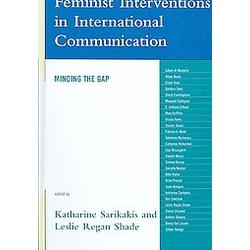
Feminist Interventions in International Communication: Minding the Gap, edited by Katharine Sarikakis and Leslie Regan Shade (Rowman & Littlefield, 2008). Table of Contents: Revisiting international communication / Katharine Sarikakis and Leslie Regan Shade -- Feminist issues and the global media system / Margaret Gallagher -- Public/private / Gillian Youngs -- Women, participation, and democracy in the information society / Ursula Huws -- The expediency of women / Alison Beale -- Gender-sensitive communication policies for women's development / Kiran Prasad -- The spectral politics of mobile communication technologies / Barbara Crow and Kim Sawchuk -- The global structures and cultures of pornography / Katharine Sarikakis and Zeenia Shaukut -- Mediations of domination / Yasmin Jiwani -- From religious fundamentalism to pornography? the female body as text in Arabic song videos / Salam Al-Mahadin -- Female faces in the millennium development goals / Nancy Van Leuven ... [et al.] -- Deadly synergies / Patricia A. Made -- Online news / Jayne Rodgers -- Convergences / Vincent Mosco, Catherine McKercher, and Andrew Stevens -- Women, information work, and the corporatization of development / Lisa McLaughlin -- Empire and sweatshop girlhoods / Leslie Regan Shade and Nikki Porter -- Feminist print cultures in the digital era / Simone Murray -- Communication and women in Eastern Europe / Valentina Marinescu -- Godzone? NZ's classification of explicit material in an era of global fundamentalism / Mary Griffiths -- Grounding gender evaluation methodology (GEM) for telecenters / Claire Buré. Available from ASC Reserve.

Research Methods in Information, by Alison Jane Pickard (Facet Publishing, 2007). This methods handbook claims to be the first of its kind to "focus entirely on research needs of the information and communications community." The publisher is overstating the later claim since handbooks on communication research are common but I like having a research methods book around that focuses on information studies, including internet research. Available in ASC reference.


Labels: , , , , ,

Thursday, September 13, 2007

Journal Roundup: Noteworthy Special Issues

You may have noticed this blog likes to highlight special themed issues of journals. Here are a few of late:

Journalism Studies, Volume 8, Number 4 (August 2007)
Mapping the Magazine, guest edited by Tim Holmes. Includes articles on For Women, women's pornography magazine; irony in men's magazines; Kate Moss and photojournlism; South Africa's Drum, women's magazines in Russia, gossip magazines in Spain, consumer magazines in South Africa and Israel, metal music magazines, and 19th Century popular science magazines.

Rhetoric & Public Affairs Volume 10, Number 2 (Summer 2007)
Rhetoric and the War in Iraq, guest edited by Herbert W. Simons. Includes an article by Kathleen Hall Jamieson, "Justifying the War in Iraq: What the Bush Administration's Uses of Evidence Reveal."

Journal of Consumer Culture Volume 7, Number 2 (July 2007)
Citizenship and Consumption, guest edited by Frank Trentmann and Don Slater.

Televizion (20/2007/E)
TV for TV Beginners, Edited by Maya Gotz. This German journal devoted to children and television limits this issue to infants through preschoolers. Not all issues of Televizion are in English but this one is.

Information Communication & Society Volume 10, Number 3 (2007)
Gender and ICT, guest edited by Clem Herman and Juliet Webster.

Social Semiotics (Volume 17, Number 3 (September 2007)
Somatechnics: Reconfiguring Body Modification, guest edited by Jessica Cadwallader and Samantha Murray. The papers that make up this special issue are drawn from the Body Modification: Mark II Conference, held at Macquarie University in 2005. Explain the editors: "The vast array of practices, discourses and texts discussed at this conference led to the coining of the neologism "somatechnics." The inextricability of soma - the body - and technics, techniques, technologies and technes is thus at the heart of a set of politicised and critical interrogations of subjectivity and bodily being. This issue, engaging as it does with such a range of body modificatory practices, offers a consideration of this newly named area of study." Articles on the corset, queer culture, colonialism and corporal punishment, the Body Worlds exhibit, the surgical imaginary, deviant (fat) bodies, and genital modification collect around this theme.

Labels: , , , , , , ,

Web Analytics