/>

Wednesday, December 15, 2010

Two New Reference Books on Social Movement Media, Political Communication

Encyclopedia of Social Movement Media, edited by John D. H. Downing (Sage, 2010). A one-volume encyclopedia featuring over 250 essays on the role of media in social movements in the 20th and 21st centuries. "Thematic essays address selected issues such as human rights media, indigenous peoples' media, and environmentalist media, and on key concepts widely used in the field such as alternative media, citizens' media, and community media. The encyclopedia engages with all communication media: broadcasting, print, cinema, the Internet, popular song, street theater, graffiti, and dance" (publisher's website).

Key themes include: Cinema, Television, and Video; Cultural Contestations; Feminist Media; Gay and Lesbian Media; Human Rights Media; Independence Movement Media; Indigenous Peoples' Media; Information Policy Activism; Internet;Labor Media; News; Performance Art Media; Popular Song; Press; Radio; and Regions.

**********************************************************************************

Sourcebook for Political Communication Research:Methods, Measures, and Analytical Techniques, by Erik P. Bucy, R. Lance Holbert (Routledge, 2010).

"...covers the major analytical techniques used in political communication research, including surveys, experiments, content analysis, discourse analysis (focus groups and textual analysis), network and deliberation analysis, comparative study designs, statistical analysis, and measurement issues. It also includes such innovations as the use of advanced statistical techniques, and addresses digital media as a means through which to disseminate as well as study political communication. It considers the use of methods adapted from other disciplines, such as psychology, sociology, and neuroscience." --Publisher's website
Look for the chapter co-authored by Kathleen Hall Jamieson with Kate Kenski (ASC alum '06) and Jeffrey Gottfried (ASC PhD candidate) titled: The Rolling Cross-Section: Design and Utility for Political Research.

Both these title can be found at in ASC Reference.

Labels: , ,

Friday, April 16, 2010

Communication Research Methods II


Communication Research Methods II: A Sourcebook, by Rebecca B. Rubin, Alan M. Rubin, Elizabeth E. Graham, Elizabeth M. Perse, and David R. Seibold (Routledge, 2009) expands on the measures included in the original 1994 volume. The authors claim that the measure they feature are:
"the best of the best from the early 1990s through today. They are models for future scale development as well as tools for the trade, and they constitute the main tools that researchers can use for self-administered measurement of people's attitudes, conceptions of themselves, and perceptions of others. The focus is on up-to-date measures and the most recent scales and indexes used to assess communication variables." --Publisher's website
Part I offers overviews of measurement research in various sub-divisions of the field: family communication, organizational and group, health, instructional, cross-cultural and intercultural, interpersonal and mass; each chapter includes a solid bibliography.

Part II contains profiles of selected communication measures, 57 to be exact. And Part III profiles "imported" measures (from other fields.)

This title (and it's 1994 predecessor), is on the shelf in ASC Reference, P 91.3 C623.

Labels: ,

Monday, February 25, 2008

New Reference Book Arrivals

New in ASC Reference:

Encyclopedia of Political Communication, edited by Lynda Le Kaid and Christina Holtz-Bacha (Sage Publications, 2008). Key themes are: Biographies, Books/Film/Journals/Television, Democracy, Democratization, Education and Nonprofit Organizations, Elections, Government Operations and Institutions, Legal and Regulatory, Media Events, Media Outlets and Programs, Role of Media in Political Systems, News Media Coverage of Politics, Political Affairs, Theoretical Approaches,Types of Political Media, Political Attitudes, Political Campaigns, Political Events, Political Groups and Organizations, Political Issues, Political Journalism, Theoretical Concepts,
Women in Politics


Information Ethics and Security, edited by Marian Quigley (Information Science Reference, 2008). Includes over 150 contributors from 19 countries on topics such as computer crime, information warfare, privacy, surveillance, intellectual property, information ethics, and education; over 2000 article references.

Sage Handbook of Public Opinion Research, edited by Wolfgang Donsbach and Michael W. Traugott (Sage, 2008). Includes "The Public and Public Opinion in Political Theories" by Vincent Price, the opening article in Part I (History, Philosophy of Public Opinion and Public Opinion Research). Other sections: The Development of Public Opinion Research, Theories of Public Opinion and Change, Dynamics of Public Opinion, The Design of Surveys, Measurement of Public Opinion, The Status of Public Opinion Research, Uses and Effects of Public Opinion Research, Special Fields of Application . "The most comprehenisve book on public opinion research to date." --Robert Ting-Yiu Chung (WAPOR)

Historical Methods in the Social Sciences, edited by John A. Hall and Joseph M. Bryant (Sage, 2006). Four volume compendium of reprints of foundational articles and chapters on methods in historical sociology.

The Language of Advertising, edited by Guy Cook (Routledge: Major Themes in English Studies, 2008). A four-volume ‘mini library’ of some of the most seminal and controversial works on the language of advertising. Sections include advertising and society, cross cultural advertising, gender and sexuality, case studies of products and campaigns, multimodal forms of advertising, and brands and branding.

The Sage Handbook on Grounded Theory, edited byAntony Bryant and Kathy Charmaz (Sage, 2007). "Grounded Theory is by far the most widely used research method across a wide range of disciplines and subject areas, including social sciences, nursing and health care, medical sociology, information systems, psychology, and anthropology...gives a comprehensive overview of the theory and practice of Grounded Theory, taking into account the many attempts to revise and refine Glaser and Strauss original formulation and the debates that have followed." --publisher's website

Journalism, edited by Howard Tumber (Routledge, 2008). Another four-volume mini-library in the Critical Concepts in Media and Cultural Studies Series, this one devoted to the social, political, cultural, and practical understanding of journalism. The volumes are designed to be a library reference of key theoretical, empirical, and historical writings on journalism derived from previously published journals and books. "Has Communication Explained Journalism" by Barbie Zelizer (first published in the Journal of Communication, 1993) appears in Volume II.


And two books by Howard Becker:

Writing for Social Scientists: How to Start and Finish Your Thesis (University of Chicago, 2007). Second edition of this classic, of sorts.

Telling About Society (University of Chicago, 2007). "...should carry a warning label: 'Do not start reading unless you're prepared to spend the next few hours having your horizons broadened and your understanding of social sciences deepened. Further, prepare to abandon any belief that insight and originality are incompatible with clarity, accessibility, and plain good writing." --Larry Gross, University of Southern California

Labels: , , , , , , ,

Monday, December 03, 2007

Highlighting two reference books

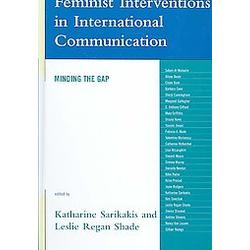
Feminist Interventions in International Communication: Minding the Gap, edited by Katharine Sarikakis and Leslie Regan Shade (Rowman & Littlefield, 2008). Table of Contents: Revisiting international communication / Katharine Sarikakis and Leslie Regan Shade -- Feminist issues and the global media system / Margaret Gallagher -- Public/private / Gillian Youngs -- Women, participation, and democracy in the information society / Ursula Huws -- The expediency of women / Alison Beale -- Gender-sensitive communication policies for women's development / Kiran Prasad -- The spectral politics of mobile communication technologies / Barbara Crow and Kim Sawchuk -- The global structures and cultures of pornography / Katharine Sarikakis and Zeenia Shaukut -- Mediations of domination / Yasmin Jiwani -- From religious fundamentalism to pornography? the female body as text in Arabic song videos / Salam Al-Mahadin -- Female faces in the millennium development goals / Nancy Van Leuven ... [et al.] -- Deadly synergies / Patricia A. Made -- Online news / Jayne Rodgers -- Convergences / Vincent Mosco, Catherine McKercher, and Andrew Stevens -- Women, information work, and the corporatization of development / Lisa McLaughlin -- Empire and sweatshop girlhoods / Leslie Regan Shade and Nikki Porter -- Feminist print cultures in the digital era / Simone Murray -- Communication and women in Eastern Europe / Valentina Marinescu -- Godzone? NZ's classification of explicit material in an era of global fundamentalism / Mary Griffiths -- Grounding gender evaluation methodology (GEM) for telecenters / Claire Buré. Available from ASC Reserve.

Research Methods in Information, by Alison Jane Pickard (Facet Publishing, 2007). This methods handbook claims to be the first of its kind to "focus entirely on research needs of the information and communications community." The publisher is overstating the later claim since handbooks on communication research are common but I like having a research methods book around that focuses on information studies, including internet research. Available in ASC reference.


Labels: , , , , ,

Wednesday, November 21, 2007

Introducing Communication Methods and Measures

The ASC Library subscribes to a new Lawrence Erlbaum journal, Communication Methods and Measures, edited by David R. Roskos-Ewoldsen (University of Alabama). The journal describes its aims in its mission statement: "...to bring developments in methodology, both qualitative and quantitative, to the attention of communication scholars, to provide an outlet for discussion and dissemination of methodological tools and approaches to researchers across the field, to comment on practices with suggestions for improvement in both research design and analysis, and to introduce new methods of measurement useful to communication scientists or improvements on existing methods. Submissions focusing on methods for improving research design and theory testing using quantitative and/or qualitative approaches are encouraged. Articles devoted to epistemological issues of relevance to communication research methodologies are also appropriate. This journal welcomes well-written manuscripts on the use of methods as well as articles illustrating the advantages of newer or less widely known methods over those traditionally used in communication."

Volume 1, Issue 3 is guest edited by Michael A. Shapiro (Cornell) and features articles on generalizability. Rounding out the issue is a an article on cultivation (The Influence of Question Fomat on the Cultivation Effect).

Bear with us, so far the journal is not available electronically but will be soon.

Labels: ,

Web Analytics