/>

Monday, February 11, 2013

Introducing Journal of Digital and Media Literacy

An interesting new journal to follow (by all, it's open access) is Journal of Digital and Media Literacy. Writes Editor  Alexis Carreiro, in Issue One's Introduction to the Journal: 

Broadly defined, digital and media literacy refers to the ability to access, share, analyze, create, reflect upon, and act with media and digital information.1 These literacies are at the heart of modern communities. The Journal of Digital and Media Literacy explores the connection of media fluency to culture and civic engagement. It examines the ways people use technology to create, sustain, and impact communities on local, national, and global levels....Our content is descriptive and prescriptive in regards to how civic leaders, media practitioners, scholars, and educators engage with all aspects of digital and media literacy throughout the communities in which they work, live, and serve. The result, we hope, is that this work will help these groups and others raise the digital media literacy rates of their own communities...

The world of traditional academic publishing is changing. We are excited to be part of that change. Publishing short and long-form academic articles alongside digital projects encourages readers to think of digital media as a source of information and an infrastructure for dialogue and discourse. Media content and form are linked. We hope our blended approach to content and format encourages JDML readers to consider how the infrastructure (the images, hyperlinks, audio, and overall design) contributes to the ideas and arguments presented here.  Online journals like ours are part of an increasing trend to expand the notion of academic publishing online.2 We see this as an exciting opportunity. We believe that peer-reviewed scholarship can be inclusive and we welcome you to the conversation.

Articles in the maiden issue include a case study on a project of the Educational Video Center in New York examining how well its digital media literacy progam promotes civic engagement, the ways in which governments and civic organizations can design engagement processes that take advantage of the affordances of the civic web in order to cultivate meaningful digital citizenship, another case study that focuses on how a global group of university students understand community in the digital age, and media ecologies of health literacy.

I'm already liking the section of this vibrant journal called Editor's Choice Links. I'm boning up on peerology from a link to the official Peerology Handbook--which is a handbook for self-learners that asks the question: "what does a motivated group of self-learners need to know to agree on a subject or skill, find and qualify the best learning resources about that topic, select and use appropriate communication media to co-learn it?" But I digress...this post is about JDML...check it out.

Labels: , , ,

Tuesday, July 31, 2012

Journal of European Television History and Culture

EuScreen, comprised of European broadcasters and audiovisual archives going back to the early 1900s up to the present, has not only recently launched it's open access site but also "the first peer-reviewed, multi-media and open access e-journal in the field of European television history and culture," Journal of European Television History and Culture.

The journal acts both as a platform for critical reflection on the cultural, social and political role of television in Europe’s past and presence and as a multi-media platform for the presentation and re-use of digitized audiovisual material. In bridging the gap between academic and archival concerns for television and in analyzing the political and cultural importance of television in a transnational and European perspective, the new journal aims at establishing an innovative platform for the critical interpretation and creative use of digitized audio-visual sources. In doing so, it will challenge a long tradition of television research that was – and to a huge amount still is – based on the analysis of written sources. In offering a unique technical infrastructure for a multi-media presentation of critical reflections on European television, the journal aims at stimulating new narrative forms of online storytelling, making use of the rich digitized audiovisual collections of television archives around Europe. All articles in the journal must make use of audio-visual sources that will have to be embedded in the narrative: not as “illustrations” of an historical or theoretical argumentation, but as problematized evidence of a research question. (Editors statement.)
The first issue, Vol 1, No 1 (2012), of the journal is titled: Making Sense of Digital Sources and is edited by Andreas Fickers, Sonja de Leeu.  

Labels: , ,

Wednesday, May 16, 2012

Journal Public Culture in For Some Changes

Read about changes in store for the prominent cultural studies journal Public Culture in the May 13th Chronicle of Higher Education. The journal, under new editorship, plans to aim for a broader audience. Sociologist and public intellectual Eric Klinenberg, one of the new editorial board members, explains that "the remade Public Culture will place greater emphasis on 'imaginative social theory' and 'vivid ethnographic writing.' It will also emphasize contemporary issues such as climate change, military interventions, the power of markets, and links between social media and social movements."

The journal will also include "'visual investigations'—images that invite readers to ponder and analyze. Some of those will run online only, alongside videos and podcast" as reported by Chronicle reporter Peter Monaghan.

You can read the full article here.

Labels: , ,

Monday, October 04, 2010

Special 100th Issue of Health Communication

A special double issue of Health Communication celebrates its 100th issue (Volume 25, Issue 6-7, September 2010). It's chock full of reflective articles on the state of the health communication field, looking back and into the future. The issue is available online from the ASC homepage. Articles include:
  • Accomplishing the Goals of Health Communication Research: Predictions, Accomplishments, and Continued Efforts
  • Commentary on “Mapping Health Communication Scholarship: Breadth, Depth, and Agenda of Published Research in Health Communication”: Implications for Reaching Practitioners With Communication Research
  • What Is Normative in Health Communication Research on Norms? A Review and Recommendations for Future Scholarship
  • The Emerging Landscape of Health Communication in Asia: Theoretical Contributions, Methodological Questions, and Applied Collaborations
  • On the Need for a Life-Span Approach to Health Campaign Evaluation
  • Media Research Contributes to the Battle Against Childhood Obesity
Other highlights in the issue include a tribute piece to our own Martin Fishbein, who passed away almost a year ago, by Marco Yzer:

  • The Impact of the Work of Martin Fishbein on Health Issues in the World
and:

A Journal-Level Analysis of Health Communication

Authors: Thomas Hugh Feeley; Rachel A. Smith; Shin-Il Moon; Ashley E. Anker

Abstract
Citation data from 2006 through 2008 were used to examine the journal citation network of Health Communication in comparison to 26 related journals indexed by Journal Citation Reports, a database published by the Institute for Scientific Information (ISI) Web of Knowledge. A recently advanced journal relatedness factor based on out-degree (i.e., cited journals) and in-degree (i.e., citing journals) citations was used to determine the network of peer journals. Results indicate Health Communication serves to link communication and health-related journals. Data were also reported on journal impact and 5-year journal impact factors. When compared to ISI-indexed communication journals, Health Communication is consistently ranked in the top 25% across impact factors and citations to the journal are consistent over the 7 years of analysis from 2002 through 2008. Methods of increasing the impact of Health Communication among journals in social sciences are discussed.

Labels: , ,

Wednesday, April 28, 2010

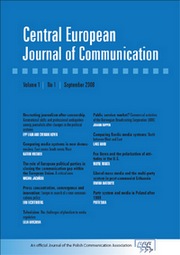
Central European Journal of Communication

The Annenberg Library now subscribes to the Central European Journal of Communication, the official Journal of the Polish Communication Association. The first issue (2008) was the "result of the International Media and Communication Conference 'Comparing Media Systems: West Meets East' (Wrocław, Kliczków Castle, 23-25 April, 2007)" from which ten articles were selected for the maiden issue. The second issue (2009), focused on the "Impact of European Integration and EU Entry on the Media and Media Policy in 'New Europe.'" "Political Campaign Communication in Different Media Systems"(2010), is the subject of the most recent issue which the library should be receiving any day now.

Note this journal is not available electronically. That will probably change at some point but for now it's a paper only title. It's also currently not indexed in Communication Abstracts or Communication and Mass Media Complete so you'll have to go out of your way a little to keep track of it (check ASC shelves or website for information on current and forthcoming issues).

Labels: , ,

Open Access Journals in Media and Communications


Here's a site to bookmark. The International Association for Media and Communication Research has compiled a list of open access journals in the field (with a brief description of each title and links to sites). Listing over 60 titles, IAMCR plans to maintain and grow this list with the help of its members and visitors to the site. They welcome suggestions of journals to add, reports of broken links and the like. As a before-summer project, I'll make sure all these titles are on the Penn Libraries Communication e-journal list--so we're all one happy family, open access e-journals sitting right amidst our subscription e-journals.

Labels: ,

Thursday, April 01, 2010

New e-Journals in Communication

Penn is a subscriber of three new ICI Global journals in the field. They are:


In additional, from MIT we now subscribe to:

International Journal of Learning and Media

The International Journal of Learning and Media (IJLM) is a ground breaking online-only journal devoted to the examination of the changing relationships between learning and media across a wide range of forms and settings. While retaining the rigorous peer review process of a traditional academic journal, IJLM will also provide opportunities for more topical and polemical writing, for visual and multi-media presentations, and for online dialogues.

These titles are all available from the ASC Library homepage.


Labels: , , , ,

Tuesday, January 12, 2010

TALKERS Magazine

The ASC Library has just opened a subscription to TALKERS Magazine, a broadcasting industry trade publication which bills itself "the Bible of Talk Radio and the New Talk Media."

Launched during the summer of 1990 by Michael Harrison, a radio broadcasting innovator and trade journalist, "TALKERS Magazine features news stories about the non-stop happenings in talk radio and the new talk media including articles about top hosts and stations, developments at the networks, interviews with movers and shakers, the opinions of industry participants and leaders, and fast-breaking developments in technology. The publication also conducts ongoing research of the topics and opinions discussed and expressed on hundreds of talk stations and programs across America and compiles them into surveys and graphs which have become the standard of the industry."

Excepts from current stories in each monthly print edition of the magazine can be accessed at available at the Talkers website. Current issues are available at the ASC Library. In addition to our subscription start-up, I purchased back issues from 2004-2009 so we have a little bit of a research cushion for this title.

Labels: , ,

Thursday, July 23, 2009

Introducing: Journal of African Media Studies

The Journal of African Media Studies has launched this year (2009) with two issues so far. The editors (Winston Mano, principal; Monica Chibita and Wendy Wilems, associates) describe the "imperatives" of the Journal in Issue Number One's opening Editorial:

"The Journal of African Media Studies (JAMS) provides a new platform to debate issues about media, communication and culture in Africa. Our first goal is to promote the often neglected but important area of media research in Africa....

The second imperative for JAMS derives from our desire to contribute to the growing body of empirical work in media, communication and cultural studies. In this regard, JAMS complements other existing English-language and area-focused media, communication and cultural studies journals that promote research on marginalized and often ignored contexts (e.g., Latin America, Middle East and Asia)....

The third related, and more political, imperative for JAMS arose from the now firm realization that the bulk of work in media theory is ‘based upon data from just two spots, Britain and the United States, which have remarkably similar leitmotifs in their cultural, economic and political history that mark them out from other nations on the planet’ (Downing 1996). We see the role of JAMS as providing perspectives that help free the field from the stranglehold of theories from one particular context (see also Ake 1982; Sparks 1998; Nuttall and Michael 1999; Park and Curran 2000; Hart and Young 2003; Abbas and Erni 2004; McMillin 2006; Thussu 2007). We aim to contribute to the ongoing re-positioning of media and cultural studies outside the Anglo-American axis. Left unchallenged, this gives rise to ‘the most often mistaken impression that the Western text and Western ways of making meaning are universal, and, therefore, to be copied by academics the world over’ (Nyamnjoh 1999)."
JAMS is among the Library's e-resources and can be accessed from the homepage.

Labels: ,

Thursday, February 12, 2009

International Journal of Communication Tackles Media Reform

Media reform is the focus of a special symposium recently published in International Journal of Communication, Volume 3 (2009). Our own Annenberg doctoral candidates Dan Berger and C. Riley Snorton contribute individual articles as well as the section's Introduction.

From the Introduction:
"This section — among the first in-depth scholarly examination of media reform—brings together scholars and activist-intellectuals (in and outside of the academy) to examine the media reform struggle. We organized this special section to investigate the ideas and actions of this political project. We wanted, in particular, to examine its origin narrative at a time when the movement appears to be gaining even greater traction as issues like “net neutrality,” low-frequency radio, and other questions of media access are pervasive in popular, scholarly, and activist spheres." They were "intentionally eclectic in soliciting a wide range of voices, which speak to issues of media, democracy, representation, and political engagement." Contributors are prominent figures in the world of media reform and the field of communication: John L. Jackson Jr. (University of Pennsylvania), "Media Reform, 2008's Presidential Election, and the Sportification of Politics"; Robert W. McChesney (University of
Illinois at Champaign-Urbana), "Understanding the Media Reform Movement"; Makani Themba-Nixon (The Praxis Project), "Mainstreams and Margins: A Critical Look at the Media Reform 'Story'"; and Peter Dahlgren (Lund University, Sweden), "Realistic Politics, Uncomfortable Knowledge: Living Creatively with Dissonance."
And be sure to also check out "From Fermentation to Maturity? Reflections on Media and Communication Studies. An Interview with Todd Gitlin, Jostein Gripsrud & Michael Schudson" by Helle Sjøvaag and Hallvard Moe.

Abstract:
"25 years after the Journal of Communication published a special issue entitled 'Ferment in the Field' [published right here at the Annenberg School], Professors Todd Gitlin, Michael Schudson and Jostein Gripsrud reflect on the state of the field of media and communications research. They discuss the conflict between critical and administrative research, the role of the intellectual in today’s society, and the quality of current research on new media."

Edited by Larry Gross and Manuel Castells (both, USC Annenberg School for Communication), IJoC is an open-access, multi-media journal that, "while centered in communication," features contributions "from the many disciplines and approaches that meet at the crossroads that is communication study." It takes the "International" part of its title seriously; beginning only its third year/volume of publication, contributors to the journal represent twenty-five countries from around the world.

Labels: , ,

Thursday, September 25, 2008

Journal of Sports Media


The Journal of Sports Media provides a broad-based exploration of sports media in terms of their practices, value, and effect on the culture as a whole. The journal features scholarly articles, essays, book reviews, and reports on major conferences and seminars. While the majority of the articles are academic in nature, it also includes articles from industry leaders and sports media figures on topics appealing to a non-academic audience.

The most recent issues features articles on interactive media and sports journalists, NFL agenda-setting in relation to programming, the birth of national sports coverage at the New York Herald with its use of the telegraph to report America’s first “championship” boxing match in 1849, and an essay on developing a sports media mafor.

The journal is available online fat the Annenberg Libary webpage.

Labels: , ,

Wednesday, December 05, 2007

International Journal of Strategic Communication


A new Lawrence Erlbaum journal, International Journal of Strategic Communication, has just completed its first year in existence. The journal is edited by Derina R. Holtzhausen and Kirk Hallahan. In the first issue the editors and some others in the lead article, "Defining Strategic Communication," orient the reader to the concept of strategic communication. They define it as [from the abstract]: "...the purposeful use of communication by an organization to fulfill its mission. Six relevant disciplines are involved in the development, implementation, and assessment of communications by organizations: management, marketing, public relations, technical communication, political communication, and information/social marketing campaigns. This years articles include "Communications Management in the Africa Context: Implications for Theory, Research and Practice"; "When Web pages Influence Web Usability: Effects of Online Strategic Communication"; "Narratives of SARS Epidemic and Ethical Implications for Public Health Crises"; "Improving Terrorism Preparedness for Hospitals: Toward Better Interorganizational Communication"; "Using Wave Theory to Maximize Investor Media Communications"; "SaveDisney.com and Activist Challenges: A Habermasian Perspective on Corporate Legitimacy"; and "Megaphones to the Internet and the World: The Role of Blogs in Corporate Communications."
We don't appear to subscribe to this journal electronically yet (all four issues are available in the ASC Library) but I notice on the open web at the Lawrence Erlbaum site the first three issues are available full-text.

Labels: , ,

Wednesday, November 21, 2007

Introducing Communication Methods and Measures

The ASC Library subscribes to a new Lawrence Erlbaum journal, Communication Methods and Measures, edited by David R. Roskos-Ewoldsen (University of Alabama). The journal describes its aims in its mission statement: "...to bring developments in methodology, both qualitative and quantitative, to the attention of communication scholars, to provide an outlet for discussion and dissemination of methodological tools and approaches to researchers across the field, to comment on practices with suggestions for improvement in both research design and analysis, and to introduce new methods of measurement useful to communication scientists or improvements on existing methods. Submissions focusing on methods for improving research design and theory testing using quantitative and/or qualitative approaches are encouraged. Articles devoted to epistemological issues of relevance to communication research methodologies are also appropriate. This journal welcomes well-written manuscripts on the use of methods as well as articles illustrating the advantages of newer or less widely known methods over those traditionally used in communication."

Volume 1, Issue 3 is guest edited by Michael A. Shapiro (Cornell) and features articles on generalizability. Rounding out the issue is a an article on cultivation (The Influence of Question Fomat on the Cultivation Effect).

Bear with us, so far the journal is not available electronically but will be soon.

Labels: ,

Wednesday, June 14, 2006

New Venture in Scholarly Publishing: International Journal of Communication

IJoC
Launching Fall 2006
A NEW VENTURE IN COMMUNICATION SCHOLARLY PUBLICATION
Editors Manuel Castells and Larry Gross
Published by
The Annenberg Center for Communication University of Southern California
This e-journal is:
• Free
• Online only
• Multimedia
• Interdisciplinary
• Adhering to the highest standards of peer review
• Engaging established and emerging scholars from around the world
The International Journal of Communication welcomes contributions that come from and speak to the many disciplines and approaches, meeting at the crossroads that is communication study.
Submit articles or subscribe to journal email updates now at: ijoc.annenberg.edu
EDITORIAL BOARD (in formation)
Editors:
Manuel Castells, USC Annenberg
Larry Gross, USC Annenberg
Associate Editors:
Jennings Bryant, U. of Alabama
Susan Douglas, U. of Michigan
Oscar Gandy, Annenberg/U. of Pennsylvania
Kathleen Jamieson, Annenberg/U. of Pennsylvania
Robin Mansell, London School of Economics
Alexander Piscitelli, U. of Buenos Aires
Marshall Scott Poole, Texas A&M
N. Bhaskara Rao, Centre for Media Studies, New Delhi
Ellen Seiter, USC Cinema-Television
Book Review Editors: (more to come)
Gustavo Cardoso, U. of Lisbon
Josh Kun, USC Annenberg
Jack Linchuan Qiu, Chinese U. of Hong Kong
Advisory Editors:
Sandra Ball-Rokeach, USC Annenberg
Svetlana Balmayeva, Liberal Arts U. of Yekaterinburg
Howard S. Becker, San Francisco
Pablo Boczkowski, Northwestern U.
William Dutton, Oxford U.
Richard Dyer, U. of Warwick
Dilip Gaonkar, Northwestern U.
Trudy Govier, U. of Lethbridge
Larry Grossberg, U. of North Carolina
James Hamilton, Duke U.
Steve Jones, U. of Illinois-Chicago
Elihu Katz, Annenberg/U. of Pennsylvania
Douglas Kellner, UCLA
Marwan Kraidy, American U.Robert
McChesney, U. of Illinois, Champaign, Urbana
Toby Miller, UC Riverside
William Mitchell, MIT
Peter Monge, USC Annenberg
Thomas Nakayama, Arizona State U.
Horace Newcomb, U. of Georgia
Dana Polan, NYU
Adam Powell, USC Engineering
Monroe Price, Annenberg/U. of Pennsylvania
Michael Renov, USC Cinema-Television
Michael Schudson, UC San Diego
John Thompson, Cambridge U.
Ingrid Volkmer, U. of Otago
Simon Wilkie, USC Communication Law and Policy
Barbie Zelizer, Annenberg/U. of Pennsylvania
Yuezhi Zhao, Simon Fraser U.

Labels: ,

Web Analytics